
New York State Master Teacher Program
The NYS Master Teacher Program fosters a collaboration among the selected outstanding k-12 STEM educators, whereby they develop expertise in the areas of content, pedagogy, and students' families and communities. The Western New York region of the NYSMTP works with 250 teachers from over 50 school districts.
FEATURED
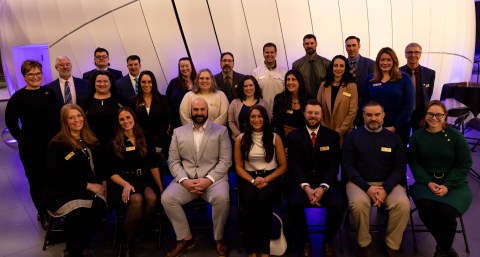
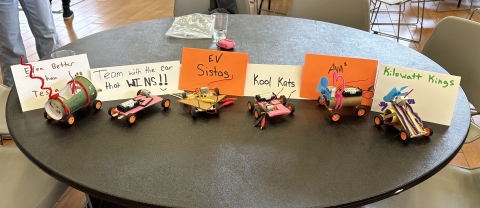
Engineering Tomorrow Electric Vehicles Design Challenge
On Wednesday, April 22, the New York State Master Teacher Program (NYSMTP) celebrated Earth Day by hosting 140 students to experience the Engineering Tomorrow EV Design Challenge. Students were introduced to the history, development, and design features of electric vehicles. The students used the material provided to design and build their own electric vehicle!
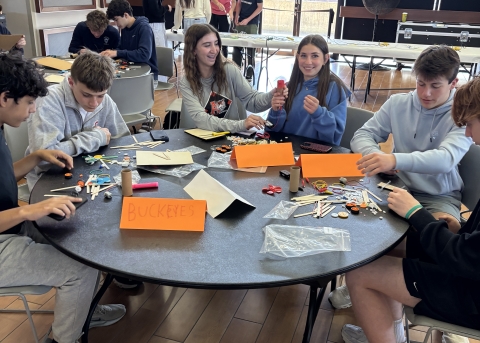
Physics Olympics
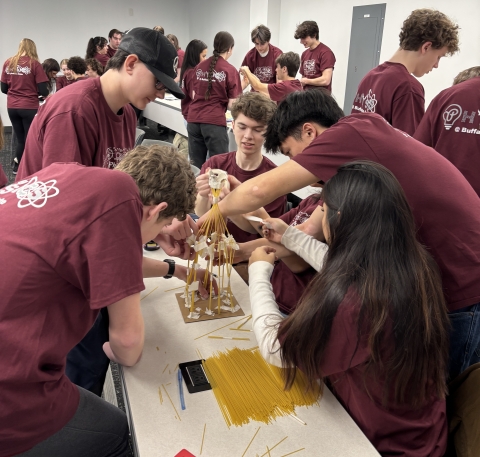
On Wednesday, March 25, 280 local high school students from 12 different schools came to Buffalo State University’s campus to compete in the annual Physics Olympics. This event was hosted by the WNY Region of the New York State Master Teacher Program (NYSMTP) and Western New York Physics Teachers Alliance (WNYPTA). Students competed in curriculum-based engineering challenges to enhance student learning, motivation, and problem-solving skills.
Click here to read more about the event!
Julia Robinson Math Festival
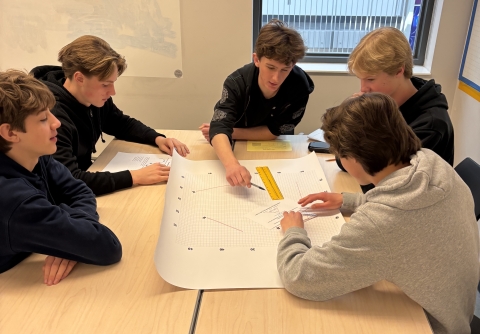
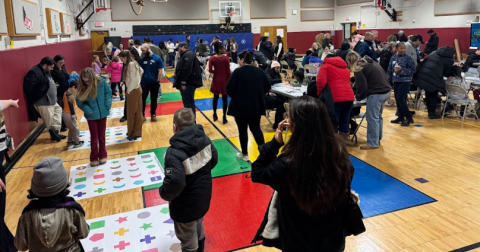
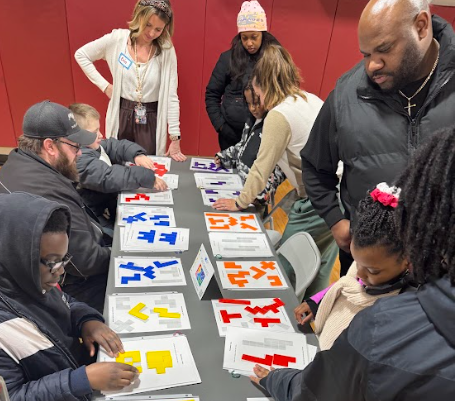
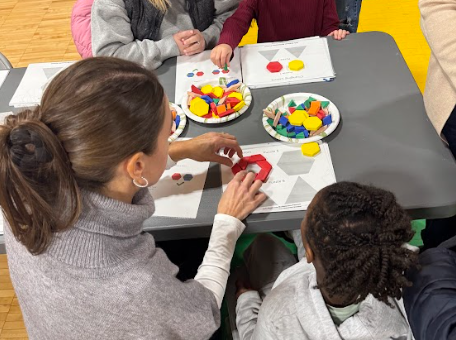
Cheektowaga Union East hosted the first Julia Robinson Math Festival (JRMF) in the Buffalo area in partnership with the NYS Master Teacher Program. It was wonderful to see students and their families having fun and doing math together. Thank you to everyone who helped make the Math Festival a huge success!
Buffalo Math Collaborative and Chautauqua Math Collaborative
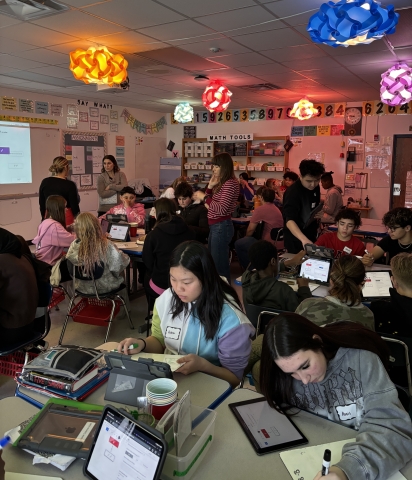
Dr. Kara Imm led the second week of meetings with our Master Teachers and participating school districts. We are excited to continue this professional development throughout the school year.
Erin McClure was recognized at the 75th Annual AMTNYS Conference as the Region A Regional Award Winner. Awardees are recognized for their collaboration, service, and impact on the profession of mathematics teaching.

Anton Banko Excellence in Elementary Science Teacher of the Year Award Winner, Bridget Lyon
Bridget Lyon was awarded the Anton Banko Excellence in Elementary Science Teacher of the Year Award at the 2025 STANYS Conference. This award recognizes a New York State K-6 teacher for demonstrated excellence in the teaching of elementary science.

NYSMTP WESTERN REGION NEWS
August 2026 - December 2026
See below for engaging PD opportunities! See full descriptions of each workshop and minicourse by clicking the link to view its flyer.
Date: Saturday, September 19th, 9am-12pm
Location: Akron Central School, 47 Bloomingdale Ave, Akron, NY 14001
September Cohort Meeting Registration
Join us for an opportunity to tour the Tonawanda Seneca community in Akron and gain a deeper understanding of the places, communities, and spaces that are an important part of our students’ lives. Led by Akron High School’s Seneca teacher, this experience offers educators a meaningful look into the community that many of our students call home.
Throughout the tour, participants will visit various areas of the reservation while learning about the Seneca Nation’s history, culture, community, and traditions. Participants will also gain valuable insight into our local demographics and the important role the Seneca Nation plays within the Akron Central School District community.
This tour is typically part of the experience provided to all newly hired Akron educators and is designed to strengthen connections between our schools, students, families, and community. By developing a greater understanding and appreciation of the community we serve, educators can build stronger relationships with students and create more meaningful connections within their classrooms.
Date: Saturday, September 19th, 1pm-3pm
Location: Tonawanda Seneca Community in Akron
Tonawanda Seneca Tour Registration
Ashokan: A day of Curiosity and Community
NYSMTP and MfA Joint Mini Conference
Date: Saturday, October 3rd, 10am-4pm
Location: The Ashokan Center, 477 Beaverkill Rd, Olivebridge, NY 12461
Joint Mini Conference Registration
August 2026 - December 2026
See below for engaging PD opportunities! See full descriptions of each workshop and minicourse by clicking the link to view its flyer.
Date: Saturday, September 26th, 9am-3:15pm
Location: Buffalo State University
Climate Summit Education Registration
Climate Summit Education Flyer
HHMI BioInteractive
This workshop is for teachers who teach any level of high school biology and environmental science, including introductory and advanced (AP/IB/Dual Credit) courses. All HHMI BioInteractive resources are free to students, teachers, and districts.
Date: Saturday, October 3rd, 9am-3pm
Location: SUNY Fredonia
HHMI BioInteractive Registration
Dates: Monday, October 19th - Wednesday, October 21st, 8am-4pm each day
Location: Jacqueline Vito LoRusso Alumni & Visitor Center, Buffalo State University

The Image Above Gives Data About the NYS Master Teacher Program
- 124,000+ students across New York State have a NYS Master Teacher
- There are 921 current Master Teachers
- More than 549 Master Teacher Emeritus
- Giving us a total of 1,470 Master Teachers statewide
- 61% Teach High School
- 15% Teach Middle School
- 15 % Teach Elementary School
- 9% Teach Across Grade Levels
- 100% of the Master Teachers state that their collaboration with other NYS Master Teachers have provided them with professional renewal and inspiration for their work as STEM educators
- 99% of MTs agree that their status as a NYS Master Teachers has increased their opportunities to develop their leadership skills.
- 97% of MTs agree that their experiences in the NYSMTP have increased their opportunities to share their work with teachers in their school or district.
- The percent of High Needs Districts with NYS Master Teachers:
- 100% Large City
- 58% New York City
- 57% Urban/Suburban/ High Needs
- 51% Rural High Needs
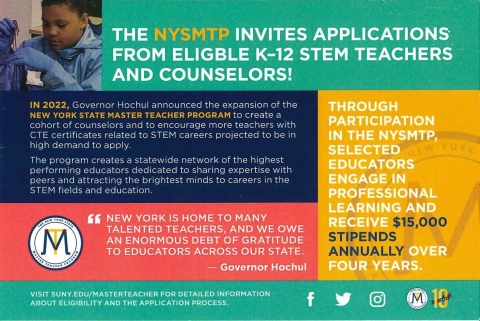
The NYSMTP invites applications from eligible K-12 STEM Teachers & Counselors! In 2022, Governor Hochul announced the expansion of the New York State Master Teacher Program to create a cohort of counselors and to encourage more teachers with CTE certificates related to STEM careers projected to be in high demand to apply. The program creates a statewide network of the highest performing educators dedicated to sharing the expertise with peers and attracting the brightest minds to careers in the STEM fields and education. Through participation in the NYSMTP, selected educators engage in professional learning and receive $15,000 stipends annually over four years. Visit suny.edu/masterteacher for detailed information about eligibility and the application process. "New York is home to many talented teachers, and we owe an enormous debt of gratitude to educators across our state." -Governor Hochul
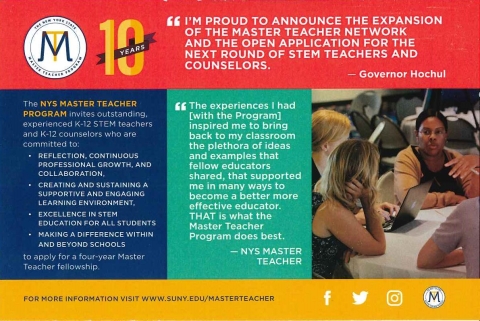
The NYS Master Teacher Program invites outstanding, experienced K012 STEM teachers and K-12 counselors who are committed to: reflection, continuous professional growth, collaboration, creating and sustaining a supportive and engaging learning environment, excellence in STEM education for all students, and making a difference within and beyond schools to apply for a four-year Master Teacher fellowship. Governor Hochul said, "I'm proud to announce the expansion of the Master Teacher network and the open application for the next round of STEM teachers and counselors.". A NYS Master Teacher said, "The experiences I had [with the Program] inspired me to bring back to my classroom the plethora of ideas and examples that fellow educators shared, that supported me in many ways to become a better more effective educator. THAT is what the Master Teacher Program does best.
"Since 2013, New York's Master Teacher program has recognized our state's most talented and dedicated educators for their persistence in engaging students in STEM fields. These teachers are instrumental in the development of our future leaders, and it is a privilege to recognize them every year."